
Watermark: Fire Safety Academy logo icon, 70 px, 45 % opacity |
Remove bibliographic source lines from image captions and descriptions |
||
| Line 1: | Line 1: | ||
== Summary == | == Summary == | ||
30-minute LC50 values for rats; a lower value means a more toxic gas. Nitrogen dioxide from burning nitrate film is about as lethal as hydrogen cyanide | 30-minute LC50 values for rats; a lower value means a more toxic gas. Nitrogen dioxide from burning nitrate film is about as lethal as hydrogen cyanide. | ||
Original illustration for [[Cellulose nitrate film]]. | Original illustration for [[Cellulose nitrate film]]. | ||
* Alt text: Log-scale bars of 30-minute LC50 for rats: HCN 165, NO2 170, HCl 3,800 and CO 5,700 µL/L; shorter bars mean more toxic. | * Alt text: Log-scale bars of 30-minute LC50 for rats: HCN 165, NO2 170, HCl 3,800 and CO 5,700 µL/L; shorter bars mean more toxic. | ||
== Licensing == | == Licensing == | ||
New drawing by Fire Safety Academy. © Fire Safety Academy. | New drawing by Fire Safety Academy. © Fire Safety Academy. | ||


Latest revision as of 08:36, 8 November 2026
Summary
30-minute LC50 values for rats; a lower value means a more toxic gas. Nitrogen dioxide from burning nitrate film is about as lethal as hydrogen cyanide.
Original illustration for Cellulose nitrate film.
- Alt text: Log-scale bars of 30-minute LC50 for rats: HCN 165, NO2 170, HCl 3,800 and CO 5,700 µL/L; shorter bars mean more toxic.
Licensing
New drawing by Fire Safety Academy. © Fire Safety Academy.
File history
Click on a date/time to view the file as it appeared at that time.
| Date/Time | Thumbnail | Dimensions | User | Comment | |
|---|---|---|---|---|---|
| current | 08:11, 8 November 2026 | 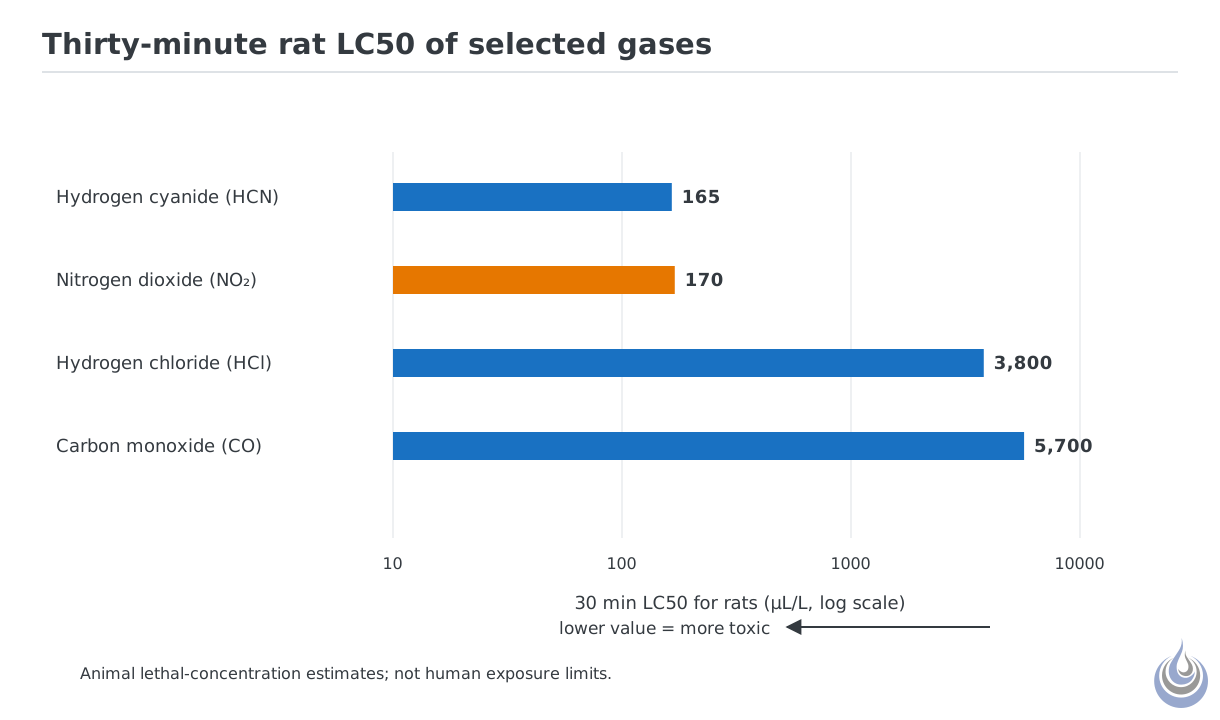 | 1,220 × 720 (6 KB) | Lisa (talk | contribs) | Watermark: Fire Safety Academy logo icon, 70 px, 45 % opacity |
You cannot overwrite this file.
File usage
The following page uses this file:
