
Contents
Fse-smoke-and-heat-exhaust-ventilation-v1.svg (SVG file, nominally 900 × 600 pixels, file size: 8 KB)
Summary
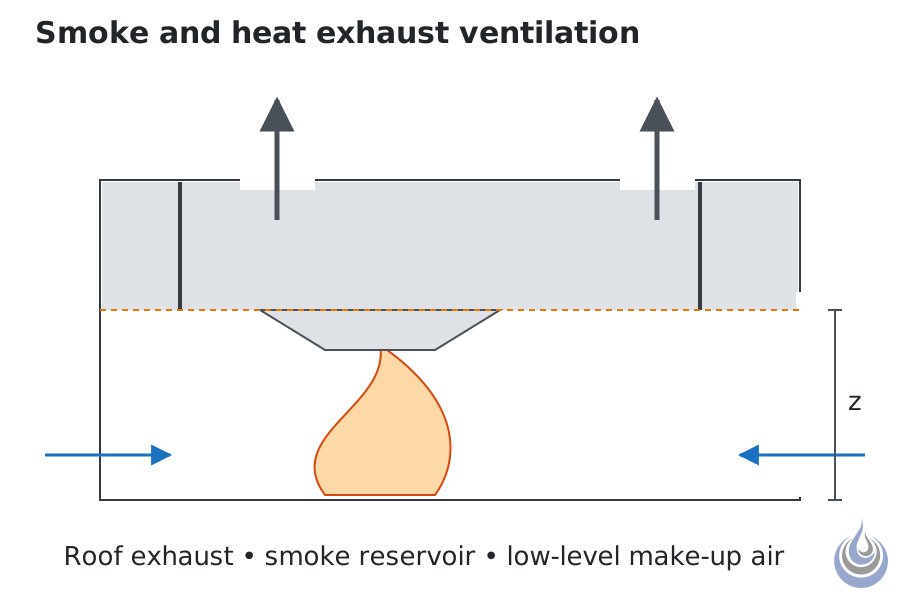
Principle of smoke and heat exhaust ventilation: the smoke removed through the roof vents balances the mass flow that the plume delivers to the layer, while replacement air enters low down. Based on Cooper (2002b), pp. 3-219 and 3-223, and Van Rossum (2027), §6.7.
Original vector illustration for Smoke and heat exhaust ventilation, level 2 Intermediate.
- Source basis: Cooper (2002b), p. 3-219 (definition, ceiling vents, curtains), p. 3-223 (low inlets 1.5 to 2 times vent area); Van Rossum (2027), §6.7 (Zukoski hood analogy, mass flow at layer interface), §3.7 (mass balance); Milke (2002b), p. 4-292 (smoke is mostly entrained air)
- Alt text: Hall cross-section: fire plume rising into a smoke layer under the roof, smoke leaving through roof vents, fresh air entering through low inlets.
Licensing
New drawing by Fire Safety Academy. © Fire Safety Academy.
File history
Click on a date/time to view the file as it appeared at that time.
| Date/Time | Thumbnail | Dimensions | User | Comment | |
|---|---|---|---|---|---|
| current | 17:26, 2 November 2026 | | 900 × 600 (8 KB) | Lisa (talk | contribs) | Watermark: Fire Safety Academy logo icon, 70 px, 45 % opacity |
You cannot overwrite this file.
File usage
The following page uses this file:
