


Contents
Fse-water-reactive-material-v1.svg (SVG file, nominally 1,310 × 825 pixels, file size: 7 KB)
Summary
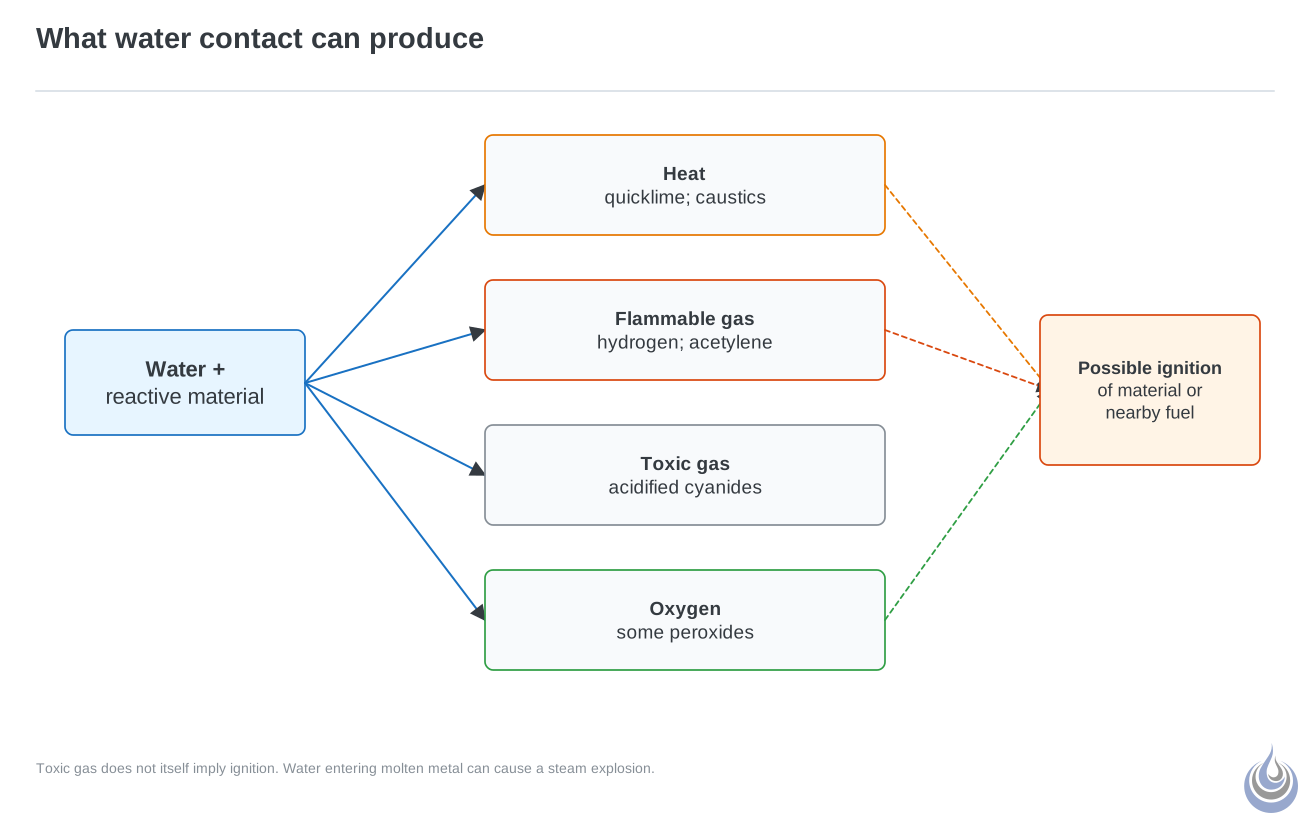
What contact with water can release from a water-reactive material, with typical examples of each group. Based on Davenport (2008), pp. 7-46–7-51 and Yu and Newman (2008), p. 2-91.
Original illustration for Water-reactive material.
- Source basis: Davenport (2008), p. 7-46 (peroxides: oxygen and heat), p. 7-48 (phosphorus pentasulfide), p. 7-50 (caustics, self-ignition or ignition of nearby combustibles), p. 7-51 (carbides, hydrides, quicklime); Yu and Newman (2008), p. 2-91 (metals give hydrogen, steam explosions, carbides give acetylene, cyanide salts); Christman (2008), p. 6-157 (magnesium)
- Alt text: Flow scheme: water meets a water-reactive material and produces heat, flammable gas, toxic gas or oxygen, each with example materials.
Licensing
New drawing by Fire Safety Academy. © Fire Safety Academy.
File history
Click on a date/time to view the file as it appeared at that time.
| Date/Time | Thumbnail | Dimensions | User | Comment | |
|---|---|---|---|---|---|
| current | 07:59, 8 November 2026 | | 1,310 × 825 (7 KB) | Lisa (talk | contribs) | Watermark: Fire Safety Academy logo icon, 70 px, 45 % opacity |
You cannot overwrite this file.
File usage
The following page uses this file:
