
Contents
Fse-adiabatic-surface-temperature-v2.svg (SVG file, nominally 900 × 600 pixels, file size: 12 KB)
Summary
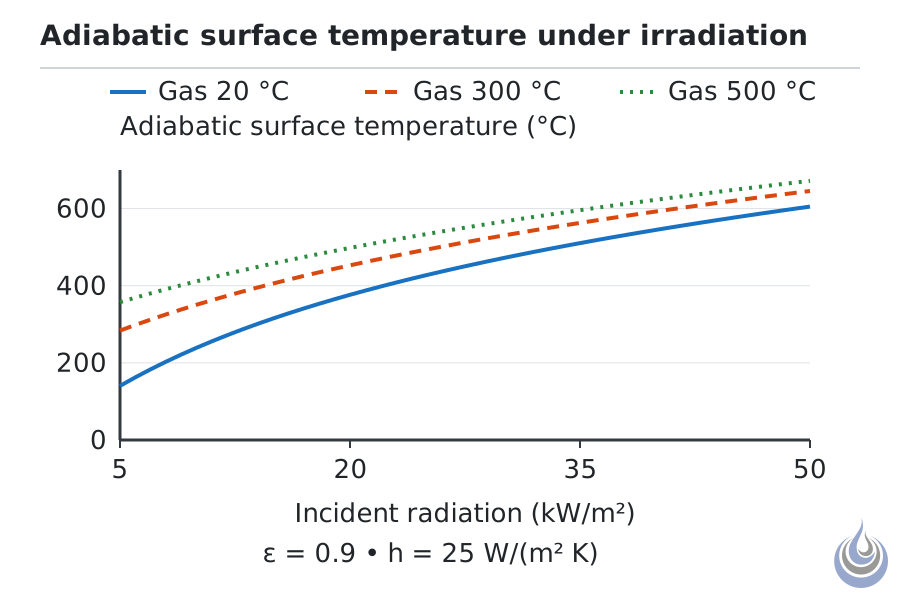
Adiabatic surface temperature of a surface with an emissivity of 0.9 and a convective coefficient of 25 W/(m²·K), against incident radiation, for three gas temperatures. Based on McGrattan et al. (2026), pp. 77–79, and Van Rossum (2027), §5.2 and §5.4.
Original illustration for Adiabatic surface temperature, level 4 Expert.
- Source basis: McGrattan et al. (2026), pp. 77–79 (heat balance terms); Van Rossum (2027), §5.2 (hc 20–25 W/(m²·K) for a fully developed fire, usually 25 for a standard fire; used here as an assumption), §5.4 (σ, emissivity 0.9 for paint), §4.7 (20 kW/m² from a 500 °C smoke layer); Gann, Hamins, et al. (2005), p. 84 (h = 25 W/(m²·K))
- Alt text: Line chart: adiabatic surface temperature rises with incident radiation; at 20 kW/m² it is 377 °C in air at 20 °C and 498 °C in gas at 500 °C.
Licensing
New drawing by Fire Safety Academy. © Fire Safety Academy.
File history
Click on a date/time to view the file as it appeared at that time.
| Date/Time | Thumbnail | Dimensions | User | Comment | |
|---|---|---|---|---|---|
| current | 17:25, 2 November 2026 | | 900 × 600 (12 KB) | Jan (talk | contribs) | Watermark: Fire Safety Academy logo icon, 70 px, 45 % opacity |
You cannot overwrite this file.
File usage
The following page uses this file:
