
Contents
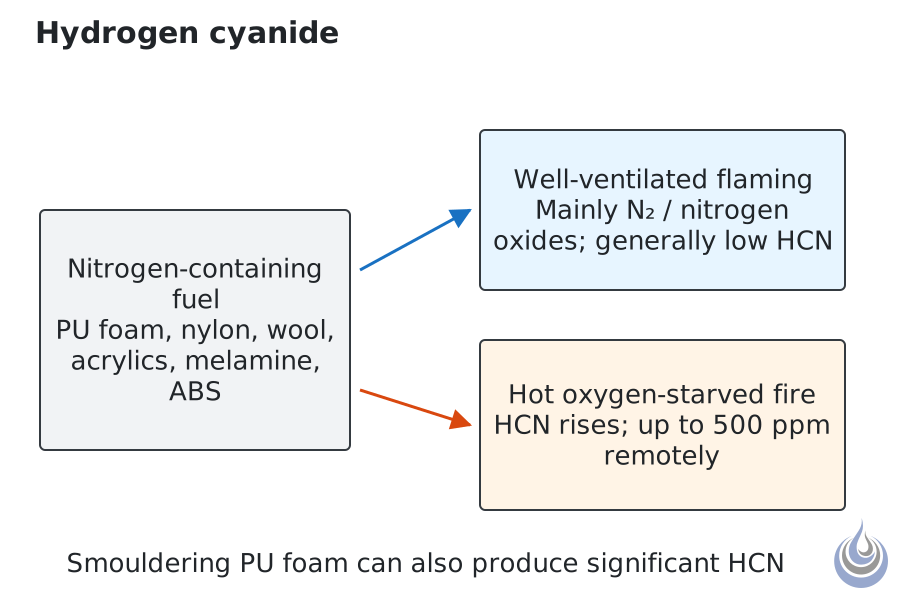
Fse-hydrogen-cyanide-v1.svg (SVG file, nominally 900 × 600 pixels, file size: 7 KB)
Summary
Nitrogen-containing materials and the burning conditions that decide how much hydrogen cyanide is formed. Based on Purser (2002), pp. 2-123, 2-153 and 2-156, and Tewarson (2002), p. 3-128.
Original vector illustration for Hydrogen cyanide, level 2 Intermediate.
- Source basis: Purser (2002), p. 2-100 (materials), p. 2-153 (well-ventilated flaming), p. 2-156 (vitiated conditions), p. 2-123 (post-flashover concentrations); Iqbal and Salley (2004), p. B-68 (urea-formaldehyde, ABS); Tewarson (2002), p. 3-128 (HCN in reduction zone, NO2 by oxidation); National Research Council of Canada et al. (2005), p. 2.4-12 (smouldering PU foam).
- Alt text: Flow diagram: nitrogen-containing materials burning with ample air give mainly nitrogen oxides; hot, oxygen-starved burning gives much hydrogen cyanide.
Licensing
New drawing by Fire Safety Academy. © Fire Safety Academy.
File history
Click on a date/time to view the file as it appeared at that time.
| Date/Time | Thumbnail | Dimensions | User | Comment | |
|---|---|---|---|---|---|
| current | 17:11, 2 November 2026 | | 900 × 600 (7 KB) | Lisa (talk | contribs) | Watermark: Fire Safety Academy logo icon, 70 px, 45 % opacity |
You cannot overwrite this file.
File usage
The following page uses this file:
