
Contents
Fse-ceiling-jet-v2.svg (SVG file, nominally 900 × 600 pixels, file size: 11 KB)
Summary
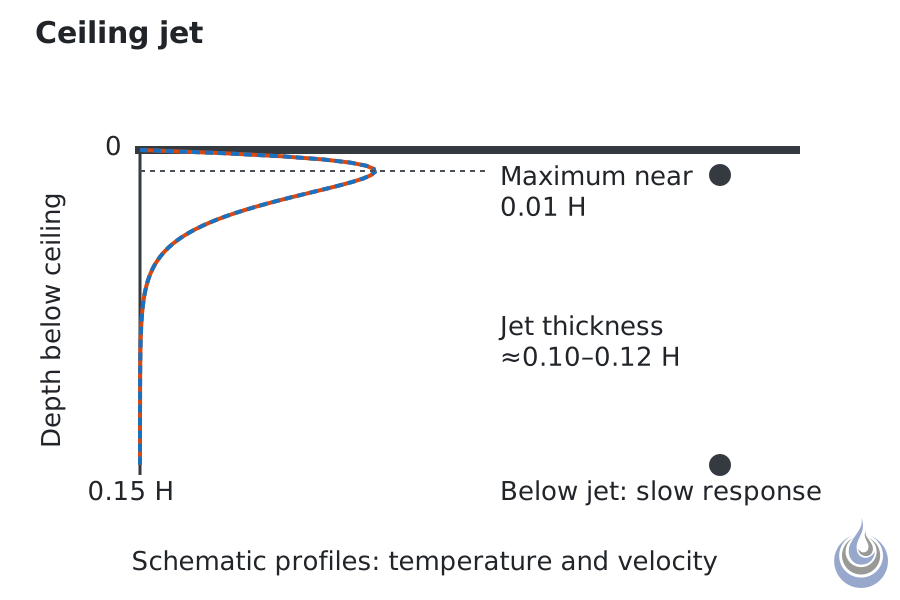
Temperature and velocity profile in a ceiling jet: the maximum lies about 1% of the fire-to-ceiling height below the ceiling, the jet is about 10 to 12% of that height deep. Based on Alpert (2002), p. 2-19, and Iqbal and Salley (2004), pp. 10-9 and 10-11.
Original vector illustration for Ceiling jet, level 2 Intermediate.
- Source basis: Alpert (2002), p. 2-19 (thickness definition 1/e, 10–12% of H, maximum at 1–2% of H, devices outside the jet); Iqbal and Salley (2004), p. 10-9 (5–12% of H, maximum at 1%) and p. 10-11 (temperature rises to a maximum then falls with depth)
- Alt text: Profile below a ceiling: gas temperature and velocity peak just under the ceiling and fall to ambient at about one tenth of the fire-to-ceiling height.
Licensing
New drawing by Fire Safety Academy. © Fire Safety Academy.
File history
Click on a date/time to view the file as it appeared at that time.
| Date/Time | Thumbnail | Dimensions | User | Comment | |
|---|---|---|---|---|---|
| current | 17:04, 2 November 2026 | | 900 × 600 (11 KB) | Lisa (talk | contribs) | Watermark: Fire Safety Academy logo icon, 70 px, 45 % opacity |
You cannot overwrite this file.
File usage
The following page uses this file:
