


Contents
Fse-thermally-thin-and-thick-materials-v2.svg (SVG file, nominally 900 × 600 pixels, file size: 10 KB)
Summary
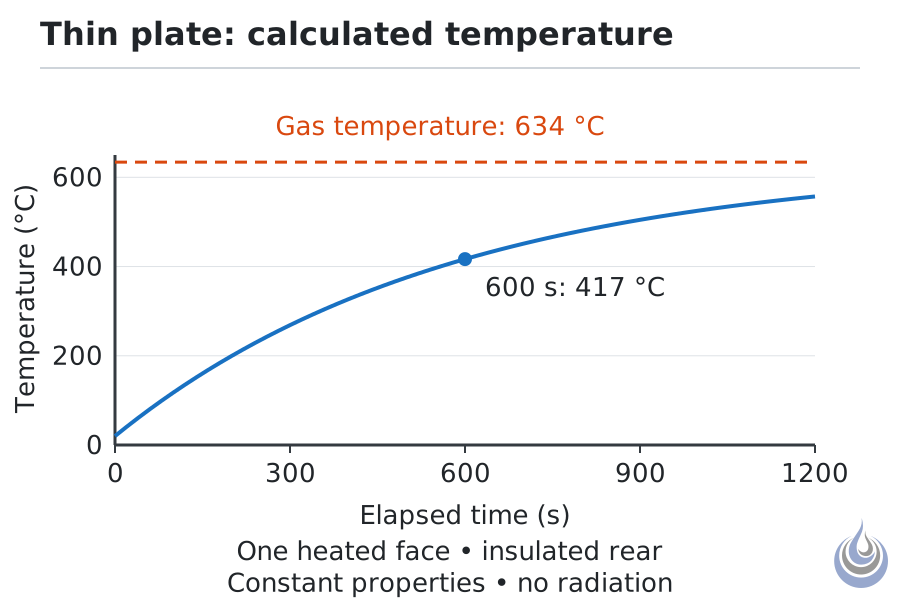
Calculated heating of the illustrative 4 mm steel plate with its rear face insulated. Based on Rockett and Milke (2002), p.1-33, and Van Rossum (2027), §§5.2 and 5.5.
Original illustration for Thermally thin and thick materials, level 3 Advanced.
- Source basis: Rockett and Milke (2002), p. 1-33; Van Rossum (2027), §§5.2 and 5.5; new illustrative calculation recorded in calculations.json.
- Alt text: A calculated steel-plate curve rises from 20 °C towards 634 °C and reaches about 417 °C after 600 s.
- Accuracy notes: Do not imply a test result, actual roof prediction or radiation-inclusive model. Use 577.76 s internally and round only displayed values.
Licensing
New drawing by Fire Safety Academy. © Fire Safety Academy.
File history
Click on a date/time to view the file as it appeared at that time.
| Date/Time | Thumbnail | Dimensions | User | Comment | |
|---|---|---|---|---|---|
| current | 16:12, 2 November 2026 | | 900 × 600 (10 KB) | Emma (talk | contribs) | Watermark: Fire Safety Academy logo icon, 70 px, 45 % opacity |
| 07:26, 2 November 2026 | 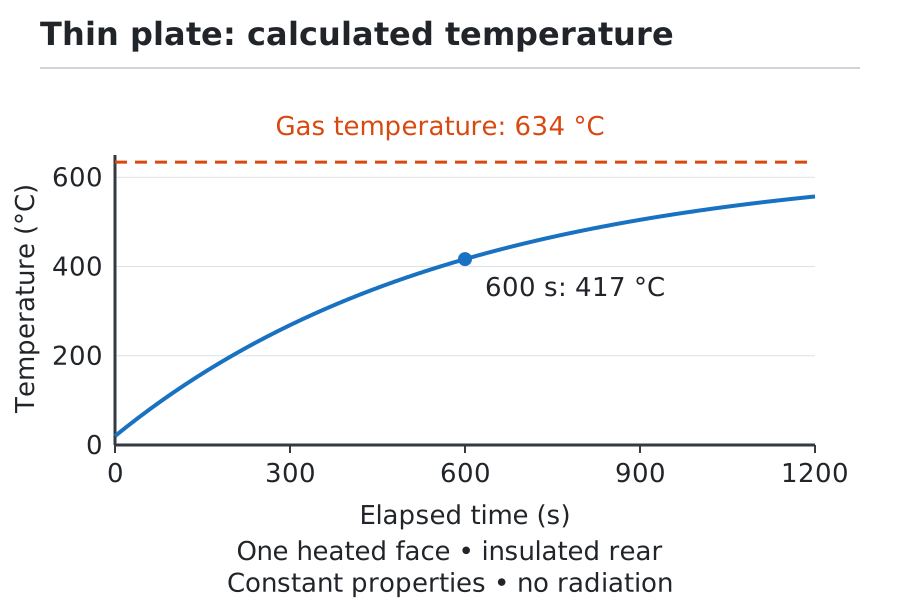 | 900 × 600 (8 KB) | Emma (talk | contribs) | Level 3 visual plan: fse-thermally-thin-and-thick-materials-v2.svg |
You cannot overwrite this file.
File usage
The following page uses this file:
