
Watermark: Fire Safety Academy logo icon, 70 px, 45 % opacity |
m Remove source references from file description |
||
| Line 1: | Line 1: | ||
== Summary == | == Summary == | ||
Net heat flux into the painted floor object of the worked example (convective coefficient assumed at 25 W/(m²·K)) against its surface temperature; the flux becomes zero at the adiabatic surface temperature of about 377 °C | Net heat flux into the painted floor object of the worked example (convective coefficient assumed at 25 W/(m²·K)) against its surface temperature; the flux becomes zero at the adiabatic surface temperature of about 377 °C. | ||
Original illustration for [[Adiabatic surface temperature]], level 4 Expert. | Original illustration for [[Adiabatic surface temperature]], level 4 Expert. | ||
* Alt text: Line chart: net heat flux into the floor object falls from 17.6 kW/m² at 20 °C to zero at 377 °C, the adiabatic surface temperature. | * Alt text: Line chart: net heat flux into the floor object falls from 17.6 kW/m² at 20 °C to zero at 377 °C, the adiabatic surface temperature. | ||
== Licensing == | == Licensing == | ||
New drawing by Fire Safety Academy. © Fire Safety Academy. | New drawing by Fire Safety Academy. © Fire Safety Academy. | ||


Latest revision as of 08:39, 13 November 2026
Summary
Net heat flux into the painted floor object of the worked example (convective coefficient assumed at 25 W/(m²·K)) against its surface temperature; the flux becomes zero at the adiabatic surface temperature of about 377 °C.
Original illustration for Adiabatic surface temperature, level 4 Expert.
- Alt text: Line chart: net heat flux into the floor object falls from 17.6 kW/m² at 20 °C to zero at 377 °C, the adiabatic surface temperature.
Licensing
New drawing by Fire Safety Academy. © Fire Safety Academy.
File history
Click on a date/time to view the file as it appeared at that time.
| Date/Time | Thumbnail | Dimensions | User | Comment | |
|---|---|---|---|---|---|
| current | 17:25, 2 November 2026 | 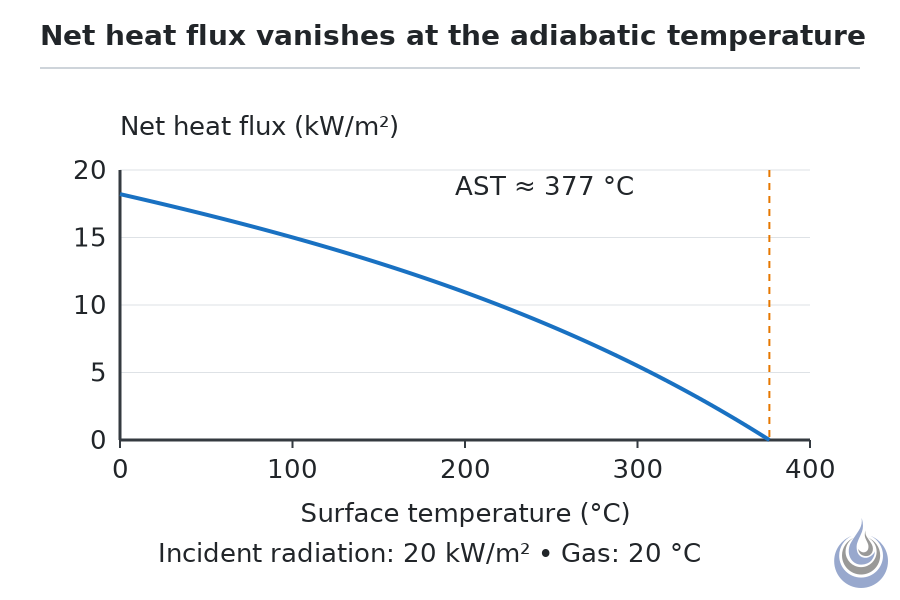 | 900 × 600 (12 KB) | Jan (talk | contribs) | Watermark: Fire Safety Academy logo icon, 70 px, 45 % opacity |
You cannot overwrite this file.
File usage
The following page uses this file:
