

Peter uploaded a new version of File:Fse-vapour-density-v3.svg |
Align the figure description with the corrected values and source in the article. |
||
| Line 1: | Line 1: | ||
== Summary == | == Summary == | ||
Density of vapour and air mixtures relative to air. Within | Density of vapour and air mixtures relative to air. Within the indicated flammable ranges, propane mixtures are at most about 5 percent and gasoline mixtures about 18 percent heavier than air. The ethyl acetate point uses the equilibrium example at 21 °C and 101 kPa, with a rounded pure-vapour density ratio of 3.0. | ||
Original illustration for [[Vapour density]]. | Original illustration for [[Vapour density]]. | ||
* Alt text: Line chart of mixture density | * Alt text: Line chart of relative mixture density against vapour concentration for propane and gasoline, with their flammable ranges highlighted by thick lines and an ethyl acetate equilibrium point at 10.25 vol. % and relative density 1.205. | ||
== Calculation basis == | |||
The ethyl acetate point is calculated from the NIST Antoine correlation at 294.15 K, total pressure 101 kPa and pure-vapour/air density ratio 3.0. The coordinates are 10.2512 vol. % and 1.20502. <ref name="NIST-EthylAcetate-Antoine">National Institute of Standards and Technology. [https://webbook.nist.gov/cgi/cbook.cgi?ID=C141786&Mask=D#Thermo-Phase ''NIST Chemistry WebBook'', ethyl acetate, Antoine Equation Parameters]. Correlation from Polák and Mertl (1965), valid from 288.73 to 348.98 K: log<sub>10</sub>(P/bar) = 4.22809 − 1245.702/(T/K − 55.189). Accessed 23 November 2026.</ref> | |||
<references /> | |||
== Licensing == | == Licensing == | ||
New drawing by Fire Safety Academy. © Fire Safety Academy. | New drawing by Fire Safety Academy. © Fire Safety Academy. | ||


Latest revision as of 18:25, 23 November 2026
Summary
Density of vapour and air mixtures relative to air. Within the indicated flammable ranges, propane mixtures are at most about 5 percent and gasoline mixtures about 18 percent heavier than air. The ethyl acetate point uses the equilibrium example at 21 °C and 101 kPa, with a rounded pure-vapour density ratio of 3.0.
Original illustration for Vapour density.
- Alt text: Line chart of relative mixture density against vapour concentration for propane and gasoline, with their flammable ranges highlighted by thick lines and an ethyl acetate equilibrium point at 10.25 vol. % and relative density 1.205.
Calculation basis
The ethyl acetate point is calculated from the NIST Antoine correlation at 294.15 K, total pressure 101 kPa and pure-vapour/air density ratio 3.0. The coordinates are 10.2512 vol. % and 1.20502. [1]
- ↑ National Institute of Standards and Technology. NIST Chemistry WebBook, ethyl acetate, Antoine Equation Parameters. Correlation from Polák and Mertl (1965), valid from 288.73 to 348.98 K: log10(P/bar) = 4.22809 − 1245.702/(T/K − 55.189). Accessed 23 November 2026.
Licensing
New drawing by Fire Safety Academy. © Fire Safety Academy.
File history
Click on a date/time to view the file as it appeared at that time.
| Date/Time | Thumbnail | Dimensions | User | Comment | |
|---|---|---|---|---|---|
| current | 18:25, 23 November 2026 | 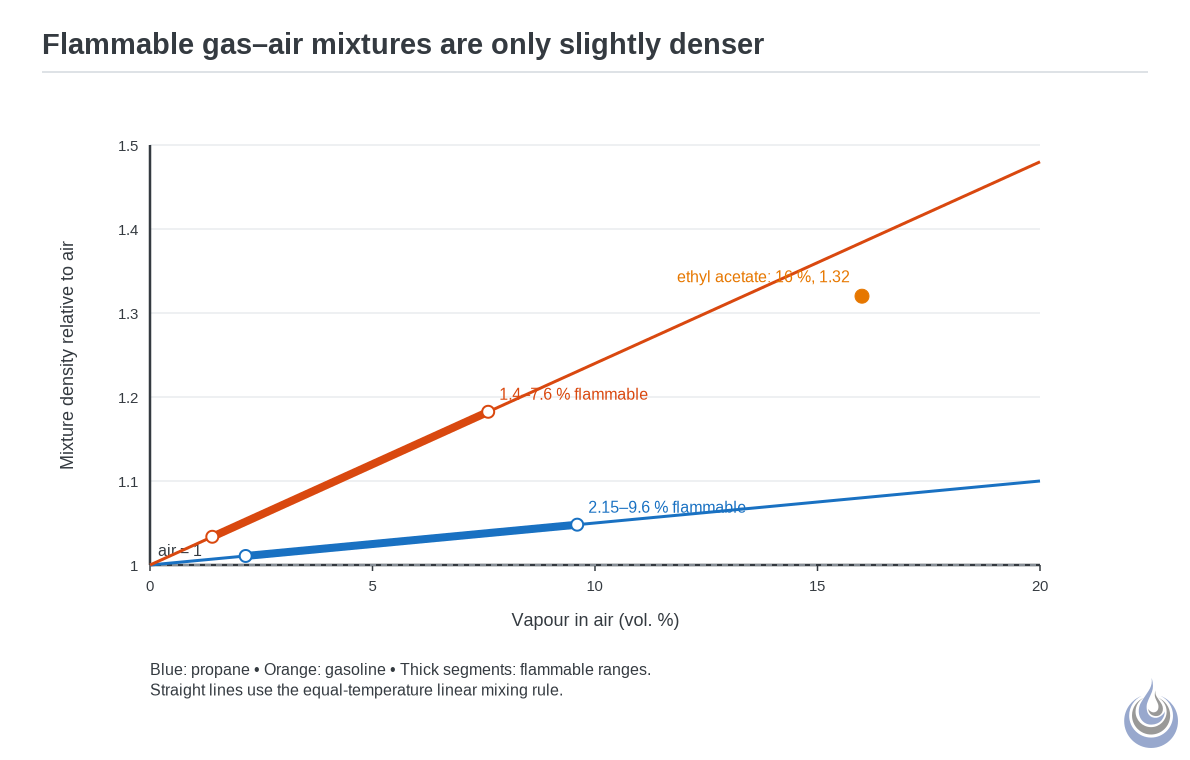 | 1,000 × 1,000 (8 KB) | Peter (talk | contribs) | Watermark: Fire Safety Academy logo icon, 70 px, 45 % opacity |
| 07:46, 8 November 2026 | 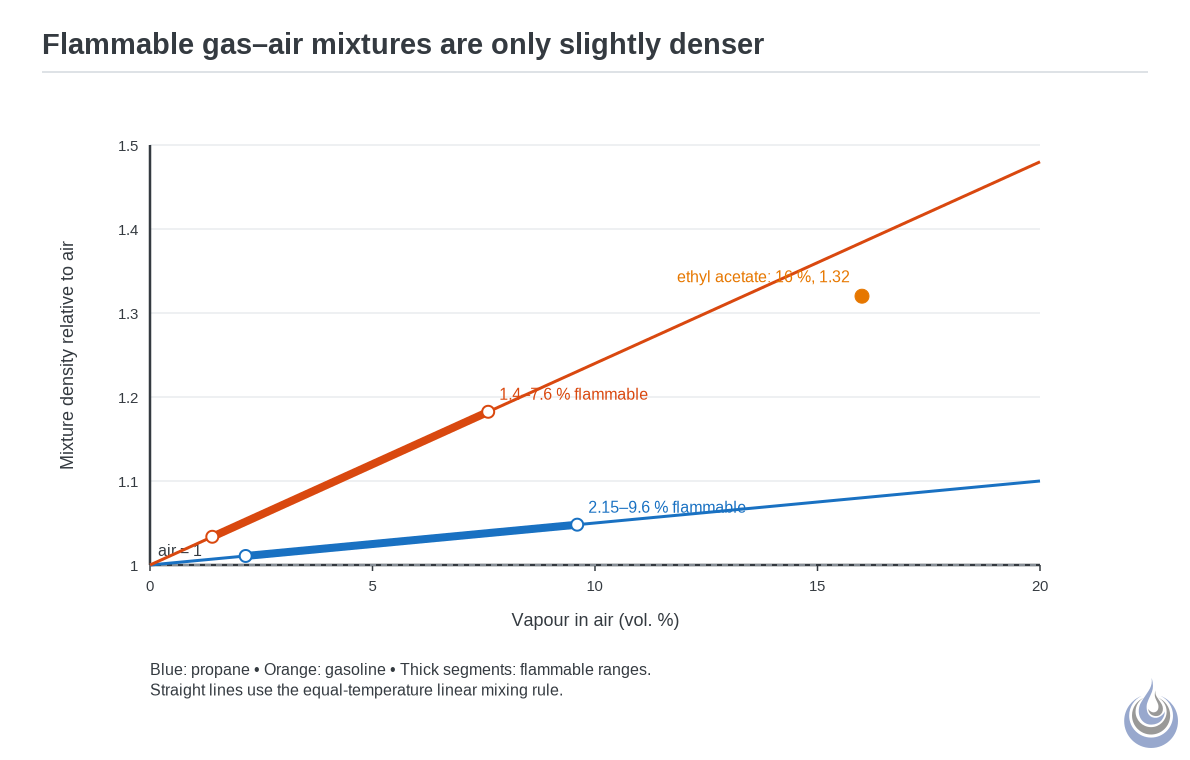 | 1,190 × 760 (10 KB) | Lisa (talk | contribs) | Watermark: Fire Safety Academy logo icon, 70 px, 45 % opacity |
You cannot overwrite this file.
File usage
The following page uses this file:
