
Watermark: Fire Safety Academy logo icon, 70 px, 45 % opacity |
m Remove source references from file description |
||
| Line 1: | Line 1: | ||
== Summary == | == Summary == | ||
Adiabatic surface temperature of a surface with an emissivity of 0.9 and a convective coefficient of 25 W/(m²·K), against incident radiation, for three gas temperatures | Adiabatic surface temperature of a surface with an emissivity of 0.9 and a convective coefficient of 25 W/(m²·K), against incident radiation, for three gas temperatures. | ||
Original illustration for [[Adiabatic surface temperature]], level 4 Expert. | Original illustration for [[Adiabatic surface temperature]], level 4 Expert. | ||
* Alt text: Line chart: adiabatic surface temperature rises with incident radiation; at 20 kW/m² it is 377 °C in air at 20 °C and 498 °C in gas at 500 °C. | * Alt text: Line chart: adiabatic surface temperature rises with incident radiation; at 20 kW/m² it is 377 °C in air at 20 °C and 498 °C in gas at 500 °C. | ||
== Licensing == | == Licensing == | ||
New drawing by Fire Safety Academy. © Fire Safety Academy. | New drawing by Fire Safety Academy. © Fire Safety Academy. | ||


Latest revision as of 08:39, 13 November 2026
Summary
Adiabatic surface temperature of a surface with an emissivity of 0.9 and a convective coefficient of 25 W/(m²·K), against incident radiation, for three gas temperatures.
Original illustration for Adiabatic surface temperature, level 4 Expert.
- Alt text: Line chart: adiabatic surface temperature rises with incident radiation; at 20 kW/m² it is 377 °C in air at 20 °C and 498 °C in gas at 500 °C.
Licensing
New drawing by Fire Safety Academy. © Fire Safety Academy.
File history
Click on a date/time to view the file as it appeared at that time.
| Date/Time | Thumbnail | Dimensions | User | Comment | |
|---|---|---|---|---|---|
| current | 17:25, 2 November 2026 | 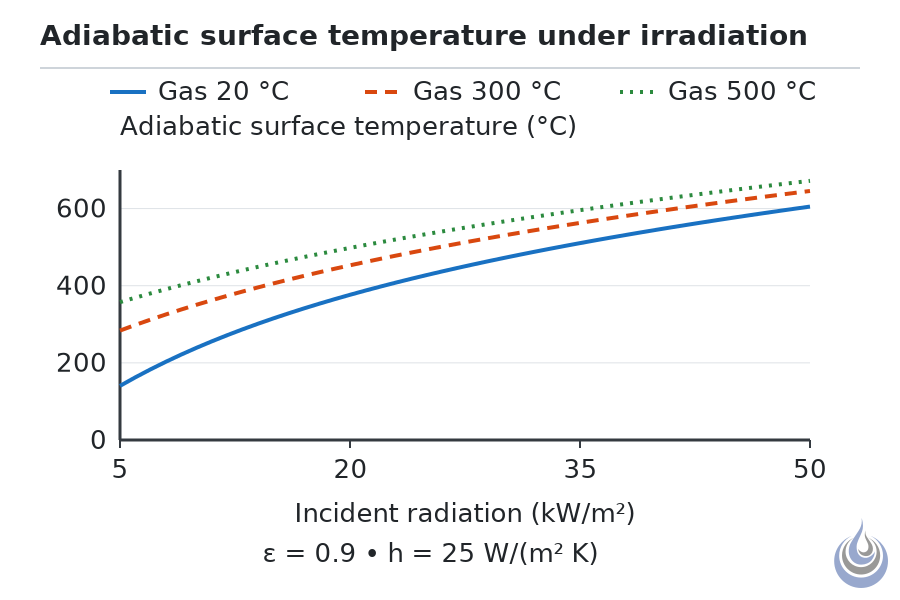 | 900 × 600 (12 KB) | Jan (talk | contribs) | Watermark: Fire Safety Academy logo icon, 70 px, 45 % opacity |
You cannot overwrite this file.
File usage
The following page uses this file:
