
Watermark: Fire Safety Academy logo icon, 70 px, 45 % opacity |
m Remove source references from file description |
||
| Line 1: | Line 1: | ||
== Summary == | == Summary == | ||
The calculated layer descends rapidly after formation in the source example | The calculated layer descends rapidly after formation in the source example. | ||
Original illustration for [[Smoke filling]], level 3 Advanced. | Original illustration for [[Smoke filling]], level 3 Advanced. | ||
* Alt text: The layer forms near 116 s, falls to 19 m at 120 s and reaches the 4 m validity boundary near 351 s. | * Alt text: The layer forms near 116 s, falls to 19 m at 120 s and reaches the 4 m validity boundary near 351 s. | ||
* Accuracy notes: Do not plot raw z/H greater than one above the roof, and do not extend below 4 m. | * Accuracy notes: Do not plot raw z/H greater than one above the roof, and do not extend below 4 m. | ||


Latest revision as of 09:26, 13 November 2026
Summary
The calculated layer descends rapidly after formation in the source example.
Original illustration for Smoke filling, level 3 Advanced.
- Alt text: The layer forms near 116 s, falls to 19 m at 120 s and reaches the 4 m validity boundary near 351 s.
- Accuracy notes: Do not plot raw z/H greater than one above the roof, and do not extend below 4 m.
Licensing
New drawing by Fire Safety Academy. © Fire Safety Academy.
File history
Click on a date/time to view the file as it appeared at that time.
| Date/Time | Thumbnail | Dimensions | User | Comment | |
|---|---|---|---|---|---|
| current | 16:33, 2 November 2026 | 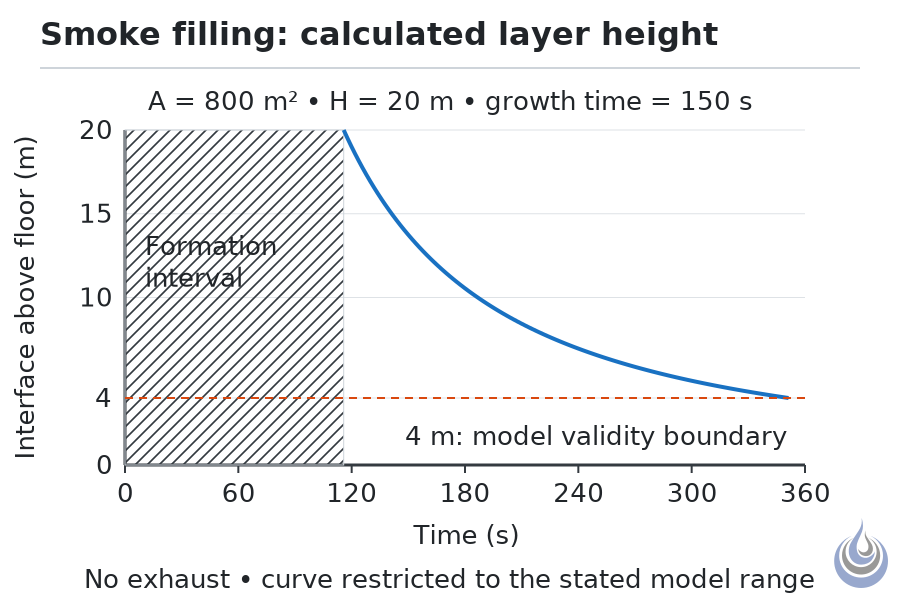 | 900 × 600 (12 KB) | Emma (talk | contribs) | Watermark: Fire Safety Academy logo icon, 70 px, 45 % opacity |
You cannot overwrite this file.
File usage
The following page uses this file:
