
Watermark: Fire Safety Academy logo icon, 70 px, 45 % opacity |
Remove bibliographic source lines from image captions and descriptions |
||
| Line 1: | Line 1: | ||
== Summary == | == Summary == | ||
Worked example: 1 kg of magnesium metal following the oxide-forming water reaction releases about 0.99 m³ of hydrogen at 20 °C, enough for about 24.7 m³ of mixture at the lower flammable limit of 4 % | Worked example: 1 kg of magnesium metal following the oxide-forming water reaction releases about 0.99 m³ of hydrogen at 20 °C, enough for about 24.7 m³ of mixture at the lower flammable limit of 4 %. | ||
Original illustration for [[Magnesium fire]]. | Original illustration for [[Magnesium fire]]. | ||
* Alt text: Sketch: 1 kg of magnesium metal, a 0.99 m³ cube of hydrogen and a 24.7 m³ cube of hydrogen-air mixture at 4 %. | * Alt text: Sketch: 1 kg of magnesium metal, a 0.99 m³ cube of hydrogen and a 24.7 m³ cube of hydrogen-air mixture at 4 %. | ||
== Licensing == | == Licensing == | ||
New drawing by Fire Safety Academy. © Fire Safety Academy. | New drawing by Fire Safety Academy. © Fire Safety Academy. | ||


Latest revision as of 08:35, 8 November 2026
Summary
Worked example: 1 kg of magnesium metal following the oxide-forming water reaction releases about 0.99 m³ of hydrogen at 20 °C, enough for about 24.7 m³ of mixture at the lower flammable limit of 4 %.
Original illustration for Magnesium fire.
- Alt text: Sketch: 1 kg of magnesium metal, a 0.99 m³ cube of hydrogen and a 24.7 m³ cube of hydrogen-air mixture at 4 %.
Licensing
New drawing by Fire Safety Academy. © Fire Safety Academy.
File history
Click on a date/time to view the file as it appeared at that time.
| Date/Time | Thumbnail | Dimensions | User | Comment | |
|---|---|---|---|---|---|
| current | 08:09, 8 November 2026 | 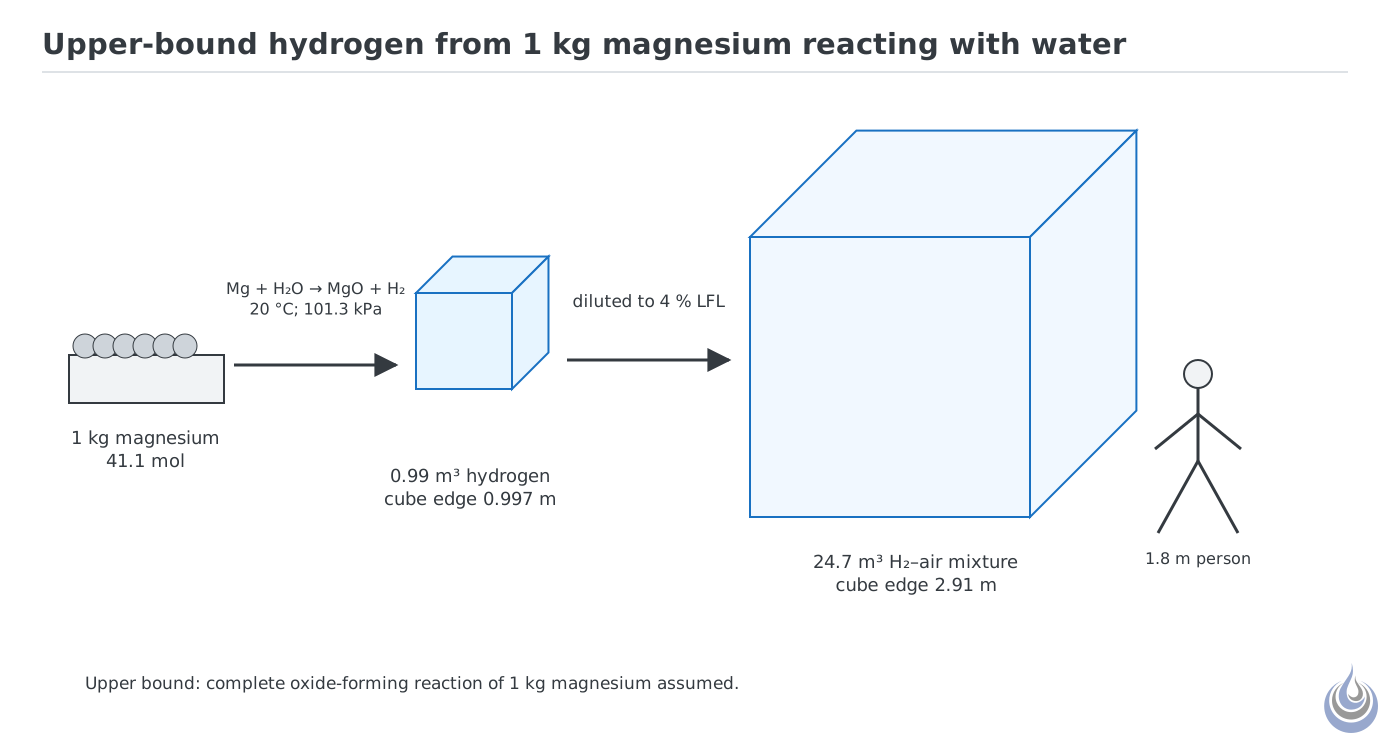 | 1,390 × 745 (7 KB) | Lisa (talk | contribs) | Watermark: Fire Safety Academy logo icon, 70 px, 45 % opacity |
You cannot overwrite this file.
File usage
The following page uses this file:
